

Tree of the Year shortlist announced showcasing UK's toughest trees

Senior PR officer
Ten tenacious trees that have defied gravity, faced the elements and even taken a hit from a cannonball are contending to be crowned the Woodland Trust’s UK Tree of the Year.
The Woodland Trust is inviting people to vote for Tree of the Year 2026, with ten spectacular specimens from across the UK fighting for the title.
This year's competition is about celebrating nature's great survivors, and has been given the theme ‘against the odds’. These arboreal miracles have faced plane crashes, Dutch elm disease, diggers, the English Civil War and cliff edges. But whatever has come their way, they have stood, clung and stayed alive for centuries – even millennia.
May Chemais, who runs the Ancient Tree Inventory at the Woodland Trust, said:
“Trees can be both tough and flexible, as the shortlist proves. Some, like yews, will rearrange their structure to keep on living, and we have two great examples of this remarkable species in the running for Tree of the Year. One is thought to have lived for 4,000 years, despite getting hit by a cannonball and its immense hollow trunk being used as a meeting room – with a door! Another defies the odds by perching, seemingly impossibly, at the top of a church tower, where it has been for two centuries.
These are just two of the fascinating trees that you can vote for, and we hope people will enjoy discovering all the incredible stories of resilience behind our nominees this year.”
Can wildcards and Scottish trees go three for three?
The Woodland Trust opened two wildcard spots to keen-eyed members of the public this year, as wildcards are on a winning streak, dominating the competition for the past two years. Both in Scotland, the remote Skipinnish Oak was crowned in 2024 and Glasgow’s Argyle Street Ash was the most recent winner in 2025.
The 2026 wildcard nominees are the Balloch Castle Ash, which sits on the southern shore of Loch Lomond, and the Donnington Oak in Berkshire, which is centuries old and lived through a 20-month Civil War siege.
Woodland Trust ambassador, the actor and nature podcaster, David Oakes, said:
“Most things survive by fleeing. A tree, rooted for life to a single patch of ground, doesn’t get that option. So trees have perfected the opposite: the art of weathering whatever arrives. But a few are frankly show-offs! The ten nominees for Tree of the Year have all defied the odds in extraordinary ways, from clinging to cliffs and church towers, to enduring collisions and cannonballs. Trees have outlived the dinosaurs. The big question now is: which tenacious British tree would you like to see crowned champion?”
The Woodland Trust's Tree of the Year competition is once again supported by players of the Postcode Lottery.
Ryan Mackie, deputy head of charities at Postcode Lottery, said:
“We're delighted Postcode Lottery players are supporting Tree of the Year 2026, and what incredible stories of surviving and thriving against the odds the shortlisted trees have. We look forward to seeing which tree comes out on top in the public vote."
Voting is open until 5pm on 29 September via the Woodland Trust website, with a winner announced in early October.
The shortlist:
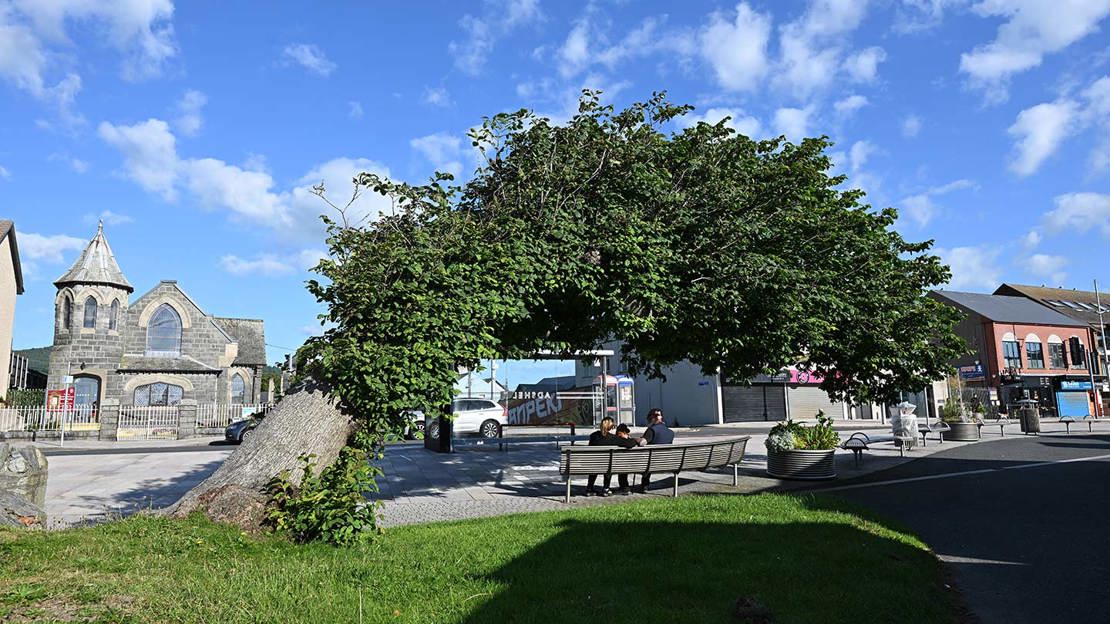
1. Bendy Tree, Newcastle, County Down
Species: wych elm
Age: 150+ years
Survived: extreme weather, development, disease
A much-loved icon of this seaside town’s promenade, the Bendy Tree grows almost horizontally, attesting to the harsh coastal conditions it has withstood for more than a century. This native wych elm has also resisted the Dutch elm disease fungus, which ravages this tree family. It was planted as part of a row of wych elms along the original promenade, likely around the mid-19th century, to shelter the main street from the wind. Many of those trees were felled in the 1980s during redevelopment, and the Bendy Tree is now the last one standing.
2. Bollihope Burn Birch, County Durham
Species: downy birch
Girth: 2.2m
Survived: extreme conditions
Clinging to a cliff face above the Bollihope Burn, this tree overlooks a picturesque spot in Weardale in the North Pennines National Landscape. The lush landscape, filled with the sound of birdsong and tinkling water, is now popular with walkers. But this area was once dominated by industry, dotted with numerous quarries, lime kilns, mines and a goods railway. This ancient downy birch has stood through it all. Perched precariously on the rock’s edge, its twisted trunk, far-reaching branches and sprawling roots give the impression the tree has almost walked, inch by inch over the years, to find purchase and save itself from the sheer drop.
3. Bomber Oak, Rutland
Species: English oak
Age: 180 years
Survived: plane crash, development
From a distance, this tree looks like many others in our countryside, but this 180-year-old oak on a family farm in Rutland knows a thing or two about survival. Standing closer, you can see it has a slight dip in the top of the canopy and twisted, misshapen central branches that have clearly suffered damage. Incredibly, it's said to have been hit by a Lancaster Bomber in 1945, with the impact slicing the tree’s top off.
The Bomber Oak recovered from the collision, but decades later, was almost lost when a water company claiming statutory powers planned to install pipes in the field. Fortunately, objections from locals including Andrew, whose family have owned the farm for several generations, were successful. The pipes had to go around the field and the Bomber Oak lives on.

4. Crowhurst Yew, Surrey
Species: yew
Age: possibly 4,000 years
Girth: 10.03m
Survived: English Civil War cannonball fire, human interference
There are many trees alive today that were growing during the English Civil War – but few were directly hit by it. In 1820, villagers discovered a cannonball embedded inside the Crowhurst Yew’s trunk, thought to be from Cromwell’s troops during target practice. The cannonball was found when villagers were hollowing out the enormous trunk to create a parish meeting room, replete with a table, benches and a door. The roof of the hollowed-out room collapsed during a storm in 1845, and yet this valiant tree lived on. It stands in St George’s churchyard, the wooden door still hinting at the tree’s remarkable past.

5. Culmstock Church Tower Yew, Devon
Species: yew
Age: 200+ years
Survived: extreme conditions
It’s no surprise that this long-living species features twice in the shortlist. But it isn’t the age of this yew that is so remarkable – it’s its location. The plucky little tree is growing at the top of a church tower overlooking Culmstock village, and has been for some 200 years.
It grows straight out of the flint rubble masonry, sustained by the lime and sand mortar and occasional waterings during hot weather. To flourish in such conditions is impressive, but to do so for two centuries is extraordinary. The tree is mentioned in a local directory from 1857, the 1894 R.D. Blackmore novel ‘Perlycross’, and poems from 1878 and 1900.
No one really knows how it got there, but reports suggest a seed could have been accidentally mixed into mortar during repairs, or carried by a bird. A third theory is that it was planted to displace evil spirits when the roof was sealed in the 1300s, known as a ‘topping out’.
The tree was reported as failing in 1904, showing signs of undernourishment and dying branches. It clearly bounced back, and modern surveys show both tree and tower remain healthy.
6. Earlstoun Lightning Oak, Dumfries and Galloway
Species: oak
Age: 475+ years
Girth: 3m
Survived: lightning strike, deforestation
Despite losing a major limb to a lightning strike many years ago, this ancient oak is still standing. A thick scar travels from the branch’s severed end, all the way down the trunk to meet the ground. The trunk grows at a noticeable angle, perhaps helping the tree to rebalance and survive after being almost split in two.
In the 1850s, this tree was recorded as 300 years old and marked on maps as the ‘Big Oak of Earlstoun’. Standing by the now-derelict Earlstoun Castle, it was once part of a vast ancient woodland, all belonging to Alexander Gordon of Earlstoun. He was outlawed after the Battle of Bothwell Bridge in 1679 but often returned to his estate, and is said to have hidden in this tree from government troops. He was eventually pardoned but was deep in debt, so sold his ancient woodland to be felled. This tree was spared, perhaps cherished for its age, or its sentimental value after it helped Alexander evade capture.
7. Preston Twin, Brighton, Sussex
Species: English elm
Age: 400 years
Girth: 6.38m
Survived: disease
This ancient English elm in Preston Park is likely the world’s oldest. It has survived four centuries, but in the face of Dutch elm disease, the last 100 years have been the toughest. The disease has wiped out millions of trees and changed the British landscape forever. This tree’s survival is testament to the council’s careful management. Rather than felling it as a preventative measure, Brighton has used beetle traps, pruned infected branches and dug trenches to prevent the disease spreading through root systems.
Another ‘twin’ elm of the same age once stood beside this special tree, and the council’s constant vigilance maintained the pair for decades, but the other Preston Twin was fatally infected in 2018. It was felled to protect the healthy elm and turned into an artwork, which stands reunited next to the surviving twin.
8. Wales Coast Path Oak, Ceredigion
Species: oak
Survived: extreme conditions
An unusual standalone oak in this mid-Wales landscape, this tree grows on the Ynys-hir nature reserve. Like a lone sentinel, it stands overlooking the Dyfi estuary, the Cambrian Mountains rising to the south and the foothills of southern Eryri to the north.
It has endured years of grazing, storms and droughts, and being on the Wales Coast Path has offered shade and shelter to many weary walkers and hungry picnickers. The harsh West Wales weather may have affected its growth, making its age harder to judge. Although small in stature, it is a charismatic tree that has survived against the odds.
9. Balloch Castle Ash, Loch Lomond
Species: ash
Age: 250+ years
Girth: 4.3m
Survived: lightning strike, disease, tourism
This unique-looking veteran ash tree dominates the west-facing lawn in front of the disused castle on the southern shores of Loch Lomond. The exposed ash is believed to have weathered a lightning strike, as well as a hurricane, multiple storms, ash dieback and heavy footfall from millions of visitors – many of whom picnic and pose for photos on its immense roots and buttressing. On 4 August 1996 the tree inadvertently attended an Oasis concert, with a prime spot in the audience, facing the stage.
Its protective position in the park, and the affection of local people and organisations, have allowed this tree to grow into a sculptural monument of strength, resilience and lochside wonder.
10. Donnington Oak, West Berkshire
Species: English oak
Age: 400–500 years
Girth: 5.8m
Survived: English Civil War siege
This majestic ancient oak would have been a young but established tree during the English Civil War. It stands between a small patch of forest and the ruined walls of Donnington Castle, and amazingly seems to have survived unscathed when the castle was held under a gruelling siege.
July 1644 saw the beginning of 20 months of assault, including 12 days of continual cannon fire from one side of the hill, which demolished three of the castle’s towers and breached the walls. This was followed by 19 days of bombardment from the opposite side of the hill, with over 1,000 shots fired. Weapons were highly inaccurate at this time and the oak was certainly within range of the attacks, so it’s no mean feat that it lived through the war – and the following three centuries – to stand overlooking the wood today.
Notes to editors
About the Woodland Trust
The Woodland Trust was established in 1972 and is now the UK's largest woodland conservation charity, with more than 500,000 members and supporters.
With a vision of a world where woods and trees thrive for people and nature, today the Trust owns and cares for more than 1,000 woodland sites, covering around 33,000 hectares.
The Woodland Trust has three key aims:
- protecting the UK's rare, unique and irreplaceable ancient woodland
- restoring damaged ancient woodland, nurturing precious pieces of our natural heritage back to life
- establishing new native woods and trees to create healthy, resilient landscapes for people and wildlife.
Access to all Woodland Trust woods is free so everyone can experience the physical and mental benefits of trees.