

Grow your own
Buy blackthorn for your garden and forage from home! There's free delivery on our beautiful fruit and nut trees, and every purchase funds our vital work for healthy woods, trees and wildlife.
Visit our tree shop
Digital content editor
You'll come across lots of edible wild plants in season in August. Here are some of the best foods for late summer foraging, with tips on where to find them and how to use them.
Enjoy exploring wild food but please follow our sustainable foraging guidelines, only picking from plentiful sources and foraging for species you can identify with certainty.
Blackberrying is probably the one traditional foraging activity that’s still widely enjoyed today. Picking blackberries, the fruit of bramble, is a pastime that’s deeply embedded in our history and folklore, going back thousands of years.

Blackberries have a high vitamin C content and can be eaten raw or cooked. There are hundreds of micro species with subtly different flavours. Gather them for pies, crumbles, wines, jams, jellies and vinegar.
This unmistakable, prickly shrub grows in woods, hedges, heathland and wasteland almost everywhere. Pick the berries when they’re a deep purple-black from late July and throughout autumn.
One of the ancestors of the cultivated apple, there are two theories on why crab apples are called crab apples. The first is that the name is derived from the Scottish form 'scrab' or 'scrabbe' (a name possibly originating from the Norse word 'skrabba'). The second is that it derives from the word 'crabbed', referring to its inferior, sour taste.
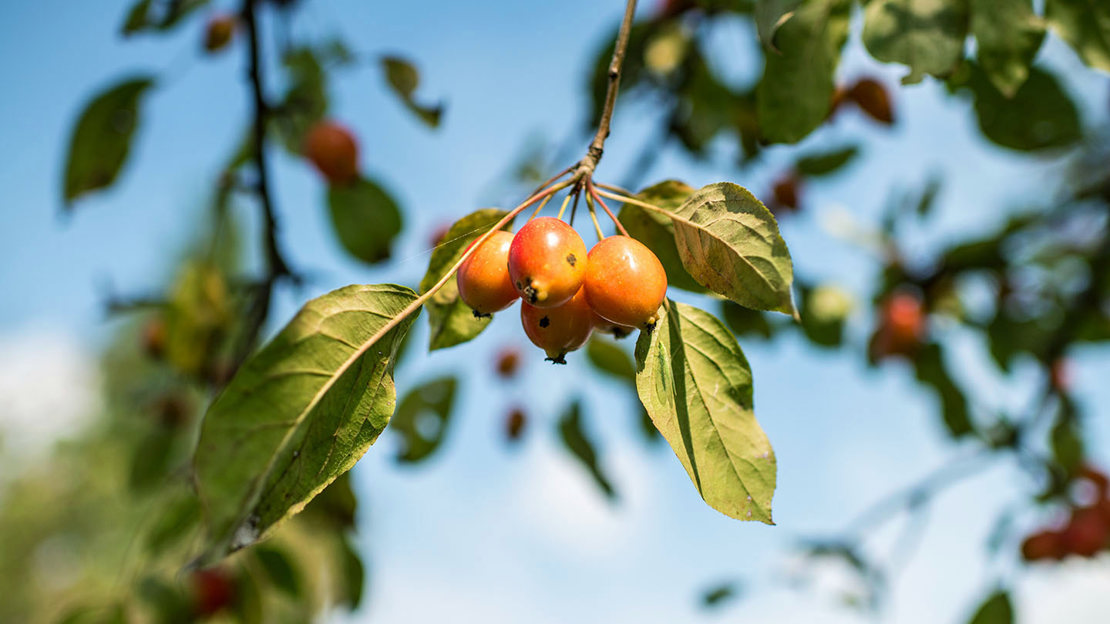
The fruits make the most incredible, sunset-coloured crab apple jelly that literally glows. It’s delicious on bread or as an accompaniment to meat, particularly chicken. Add crab apples to other jams and jellies too as their high pectin content will ensure a good set.
Crab apple trees are found throughout the UK and their apples are ready from late summer into autumn (August to October). Crab apples can turn red when they’re ripe or turn a yellowish-green or orange.
Buy blackthorn for your garden and forage from home! There's free delivery on our beautiful fruit and nut trees, and every purchase funds our vital work for healthy woods, trees and wildlife.
Visit our tree shopAn easy to recognise late summer fruit. The name elder comes from the Anglo Saxon word 'aeld' meaning fire. This refers to the hollow young stems that were once used for blowing air into a fire.

Elderberries are packed with vitamins and are most commonly used to make a refreshing cordial or fruity wine. They can also be added to pies, crumbles or hedgerow jam. Just be sure to cook the berries before consuming them, as this removes the toxins which make elderberries mildly poisonous when raw.
Elder trees are widespread and easily found in woodland and hedgerows. The small, dark red-black berries hang in neat clusters and are normally ready to harvest in August and September.
Like many other plants, greater plantain is often considered a weed that grows almost everywhere. The name comes from the Latin 'plantago', which comes from 'planta', referring to the foot-shaped leaves.

The leaves of greater plantain are quite tough so they are better when blanched and sautéed with butter, but the leaves can be eaten fresh in salads.
Look for this rosette-shaped plant in fields, lawns, roadsides, waste ground, parks and disturbed ground. Its leaves are broad and oval with characteristic parallel veins that run from the bottom of the leaf to the top. The young leaves are best for eating.
A common tree in woods, hedgerows and gardens, hazel bears its crop of nuts (also called cobnuts and filberts) from late August.

If you’re picking hazelnuts early in the season, when they’re still green, the shelled nuts make a tasty nibble to munch on while you’re out walking. If you collect enough, the shelled nuts can be roasted in the oven or used to make hazelnut butter.
It might be advisable to collect hazelnuts when they’re still young and green in late August to mid-September. If you wait until later in the year in the hope they’ll ripen, they’ll probably get taken by squirrels.
A surprisingly common plant of the UK countryside, the wild raspberry generally produces smaller, darker fruits than cultivated varieties, appearing in summer and early autumn. The leaves have traditional uses in alleviating digestive issues and menstrual cramps.

Enjoy the sharp, sweet taste of wild raspberries straight away. Alternatively, they can make a delicious wild raspberry jam, or be used in desserts, cakes and sweet treats in the same way as store-bought raspberries, or as a fun topping for yoghurts or porridge.
Wild raspberries can be found in open woodland and scrub, as well as along roadsides and occasionally in hedgerows. The fruits are difficult to mistake for anything other than unripe blackberries. While raspberry plants and brambles look similar, raspberries have much smaller red thorns on the stems.
This tree is also known as mountain ash or, in old Celtic, 'fid na ndruad' which means wizards' tree, reflecting its long association with magic and witches. Rowans were once planted to protect farm cottages from roaming witches and can still be seen around many farmyards.

Rowan berries are bitter and inedible when raw, but can be cooked to make delicious, slightly bitter jams and jellies, or can be preserved in syrup. Jelly and preserved fruit are traditionally eaten with game in the UK. To concentrate their sweetness they can be pickled, dried or frozen and then cooked. In Europe, the berries are used to make rowan schnapps.
Rowan trees are widespread. Look for their distinctive pinnate, ash-like leaves, although they are smaller with more leaflets. Dense clusters of flowers appear in early summer followed by clusters of bright red to orange berries in late summer. Collect as a cluster from the tree.
A few handfuls of fresh, ripe rowan berries
Vodka
A large, sterilised jar with a tight-fitting lid
Rinse the berries thoroughly.
If you're picking in August, before the first frost, you could put them in the freezer for a couple of weeks – it may make them sweeter.
Fill two thirds of the jar with the berries and then add the vodka.
Screw the lid on tightly and shake the jar. Store it in a cool, dark place for four weeks, shaking the jar every few days.
Strain the mixture into a clean, sterilised jar or bottle and store for another eight weeks before serving.
Enjoy!
Buy blackthorn for your garden and forage from home! There's free delivery on our beautiful fruit and nut trees, and every purchase funds our vital work for healthy woods, trees and wildlife.
Visit our tree shop


