

Fact file
Habitat: gardens, parks and the wider countryside.
Favourite plants: raspberry, comfrey, bramble and many more.
When to see: February–August.

Digital Content Manager
With almost 300 types of bee in the UK, telling the difference between them can feel daunting. Our detailed guide to some of the most common UK bee species is a great place to start.
There are around 270 bee species in the UK. One of these is the honeybee, 24 are bumblebees and close to 250 are solitary bees, which include species of mining bee and mason bee. The best way to tell them apart is by looking at their body shape, size, markings and lifestyle.
Big, clumsy and fluffy – bumblebees are hard to miss. They’re a social species, nesting in colonies numbering hundreds with a queen, workers (female bees) and drones (male bees).
Here’s how to identify common bumblebee species.

Habitat: gardens, parks and the wider countryside.
Favourite plants: raspberry, comfrey, bramble and many more.
When to see: February–August.
Despite only arriving in the UK in 2001, tree bumblebees are one of our most common species. They live in all manner of urban and rural habitats and are a garden regular, even colonising bird nest boxes. They’re easily identified by their completely ginger thorax, black abdomen and white tail.

Habitat: gardens, parks and the wider countryside.
Favourite plants: dandelion, knapweed, lavender.
When to see: March–September.
These pretty bees can be spotted almost anywhere, from gardens to rural grassland. They tend to nest in underground or enclosed spots, including old mammal burrows, and hibernate in north-facing banks in open woodland. Female red-tailed bumblebees are the easiest to identify – they’re jet black and have a bright red-orange tail. Males have a yellow head and collar, a yellow midriff band and a red-orange tail.

Habitat: gardens, parks and the wider countryside.
Favourite plants: no strong preferences, but it struggles to drink from long tubular flowers due to its short tongue.
When to see: March–August.
The classic bumblebee – females are black with a lemon-yellow collar, yellow abdominal band and a bright white tail. Males also have a white tail but often have broader yellow bands, as well as yellow facial hair and a yellow tuft on top of their head.
Queens look very similar to buff-tailed bumblebee queens, which have a browner collar and an orange-tinted tail, and workers of the two species are virtually impossible to tell apart at a glance.
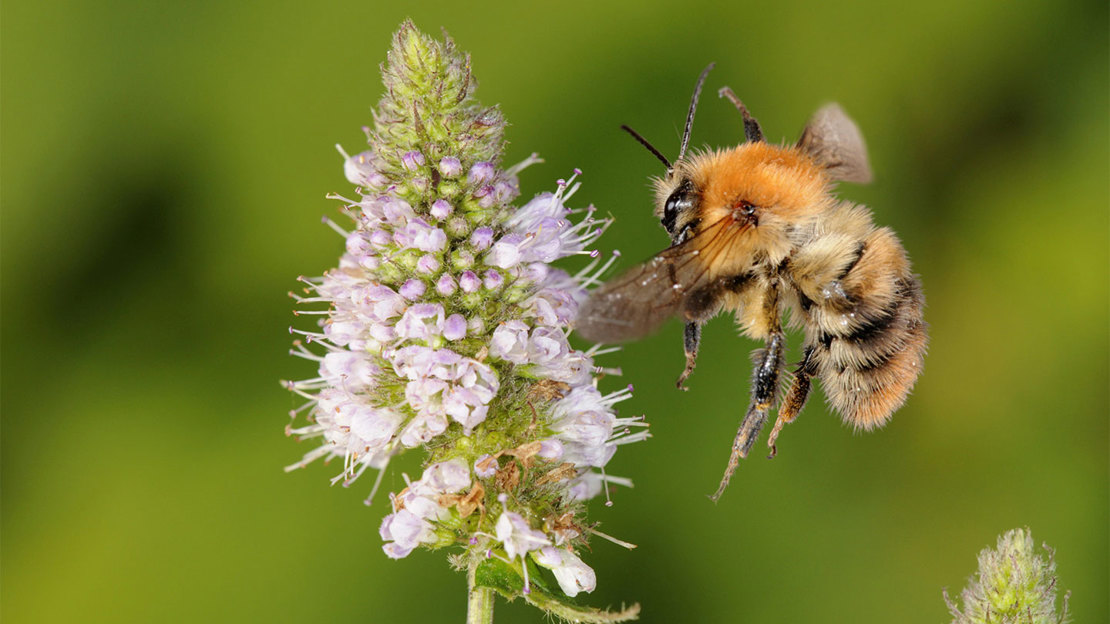
Habitat: gardens, parks and the wider countryside.
Favourite plants: clovers and vetches, amongst others.
When to see: March–October.
The only UK species with all-brown colouring and no white tail. They range from ginger to a pale, sandy brown, depending on how sun-bleached they are. They have one of the longest flight periods of any of our bumblebees and nest on the surface of the ground amongst long grass or mossy vegetation.
Buy wildflower seed balls and bee houses from our shop and turn your garden into a five-star getaway for bees and other pollinators.
Shop nowWe have just one species of honey bee in the UK. Most colonies come from domesticated populations and native populations are now extremely rare.

Habitat: gardens, parks and the wider countryside.
Favourite plants: dandelion, gorse, willow, hawthorn, roses.
When to see: March–September.
Honey bees have a slim, sandy thorax and a black abdomen with golden-amber bands. They live in hives of up to 50,000 and are commonly found feeding on open flowers they can easily access with their short tongues, including those of trees, herbs and shrubs.
There are close to 250 types of solitary bee in the UK – that’s around 90% of UK bee species! Solitary bees are a huge group including mason bees, mining bees, leaf-cutter bees and countless more. Here are some of the more distinctive and common ones.

Habitat: urban areas, parks, gardens.
Favourite plants: spring flowering plants, apple, pear.
When to see: March–June.
Female red mason bees have a black, boxy head with distinctive, inward-curving horns – a feature not seen in any other British bee species. Both sexes have a brown thorax and orange abdomen and males have white hair on their face, a little like a moustache!
These bees live in a variety of habitats and are one of the most common types of mason bee in built-up environments. They’ll nest in cracks in mortar, bee hotels, bramble stems and soil banks.

Habitat: gardens, parks and the wider countryside.
Favourite plants: buttercup, dandelion, hawthorn, blackthorn, maple, willow, fruit trees.
When to see: March–June.
Females have a thick orange coat and black face. Their thorax is a rich ginger colour, while their round rump is a brighter orange. Males are much smaller, slimmer and paler, with a white moustache.
Like all solitary bees, the tawny mining bee nests alone rather than a colony made up of workers and a queen. Females dig a hole in light soil and excavate a vertical burrow around eight to 12 inches long, with several brood cells branching off it. They fill these with a mixture of nectar and pollen, then lay an egg in each cell. Sometimes, more than 100 females may build nests within a few square metres of each other.

Habitat: open, sunny sites in places with sandy soil across gardens, parks and the wider countryside.
Favourite plants: buttercup, hawthorn, dandelion, blackthorn, gorse, fruit trees.
When to see: March–June.
A stunning little mining bee with monochrome stripes. Like the tawny mining bee, it nests in underground tunnels amongst grass and short turf, leaving a volcano-like mound of earth behind as it excavates. The ashy mining bee is known to seal over its burrow entrance once it has finished foraging for the day, or if it starts raining.

Habitat: gardens, parks, verges and the wider countryside.
Favourite plants: a wide variety of flowers including dandelion and umbellifers.
When to see: March–June
One of the earliest UK bees to emerge in spring. Females are easily recognised by their foxy-coloured thorax, the dusting of light hairs on their legs and the tuft of orange hairs at the tip of their black abdomen. They nest in holes in light soils on south-facing banks.

Habitat: gardens, parks and the wider countryside.
Favourite plants: lungwort, primrose, dead-nettle, comfrey.
When to see: February–June
Often confused for small bumblebees but their quick, darting flight sets them apart. Males are ginger-brown in colour, with cream-coloured hair on their face and long, feathery hairs on their feet. Females lack these comical hairs and are black all over, with red-orange hairs on their hind legs.
Male hairy-footed flower bees will patrol flowers in search of a mate, even chasing other insects out of their territory!

Habitat: gardens, parks, coast.
Favourite plants: knapweed, thistles, bramble, burdock.
When to see: June–September.
One of our most common leafcutter bees and easily recognised by the bright orange pollen brush on the underside of its abdomen. The female cuts neat semicircles out of the leaves of plants including roses, willowherbs, honeysuckle, lilac, birch, ash and horse chestnut, using them to line and seal the cells in their nesting tunnels. They make these in natural cavities like bramble stems and dead wood as well as bee hotels, bee bricks and holes in walls.

Habitat: woodland rides, gardens, chalk downland, soft cliff areas.
Favourite plants: toadflax, plants from the pea and mint families.
When to see: May–August.
One of the few types of bees in the UK where the male is larger than the female – and they have an attitude to match! Male wool carder bees will fiercely guard a patch of flowers for their mate and often attack trespassers with spikes on their abdomen! Female wool carder bees live a more wholesome life, collecting soft woolly fibres from plants like lamb’s ear to line their nest cavities in hollow stems, dead wood and man-made structures.
Both male and female wool carder bees are dark and have yellow spots down each side of their abdomen.

Habitat: gardens, parks and the wider countryside.
Favourite plants: ivy.
When to see: August–November.
Ivy bees were first spotted in the UK in 2001. Their densely haired thorax is a bright orange colour, and they have broad yellow-orange stripes on their abdomen.
Ivy bees emerge in late August to coincide with flowering ivy. Males gather at the entrance to females’ nest holes and begin a fierce competition to mate. Multiple male ivy bees often target the same female and become entangled in a frenzied mating ball.

Habitat: anywhere that the host Andrena nests are found.
Favourite plants: a wide variety of flowers.
When to see: April–June.
Nomad bees are the cuckoos of the insect world. They lay their eggs in the nests of different types of mining bee, with Gooden’s nomad bee targeting Andrena species. After the egg hatches and the larva goes through its first moult, it kills the host egg or grub before consuming the bee's pollen store and reaching adulthood in the host’s nest.
Gooden’s nomad bee is one of the most common nomad bees in the UK, with a wasp-like appearance and orange legs. Lots of nomad bees look very similar, but the absence of red patches on the abdomen and the unbroken, second yellow abdominal band are good indicators that you’re looking at Gooden’s nomad bee.

With our essential Trees for Bees pack you can create a wildlife haven for bees and other pollinators. Each pack includes a mix of nectar-giving native tree species.
Buy the pack
Blog
Helen Keating • 18 Mar 2019

Blog
Charlotte Varela • 26 Apr 2023

Blog
Hannah Vickers • 17 Apr 2020

Blog
Charlotte Varela • 18 Nov 2022

Trees woods and wildlife
Bees, wasps and ants all form part of the insect order Hymenoptera, a large and diverse group made up of 'membrane-winged' insects. Find out more.

Blog
Charlotte Varela • 12 Mar 2024