Bluebells flower between April and May, so go on a spring adventure with your family to discover a dazzling display.

Children's spring crafts: 11 easy flower ideas
Content manager
Spring is in the air and nature is blooming, so we've gathered our favourite arts and crafts to help you inspire children about flowers.
These easy spring craft ideas use everyday items from around your home. Discover tissue paper bluebells, toilet roll tulips, cupcake daffodils and collages made from recycled materials. There are art projects for all ages and abilities too, from finger painting and mosaics to flower pounding and watercolours. Enjoy!
1. Tissue paper bluebells
A carpet of bluebells is one of spring’s most spectacular sights. Take inspiration from this woodland wonder and make your own bluebells with this tissue paper craft.
Younger children can have fun making individual flowers, while older children can enjoy making a woodland brimming with beautiful blooms.
Materials you’ll need
- purple and green tissue paper
- green and brown crayons
- card
- scissors
- glue
How to make
- Whether you’re making one flower or a whole carpet of bluebells, you’ll need to cut your tissue paper into small squares and scrunch it up into balls.
- For single flowers, draw a tall, curved stem with long green leaves. Glue purple tissue paper along the rounded part of the stem to create the iconic bell-shaped flower heads.
- To make a woodland scene, start by drawing tree trunks along the middle of your card. Glue green tissue paper around the top of the trunks and fluff it up to create a leafy canopy. Glue purple tissue paper around the base of the trunks, interspersed with bits of green, to create a thriving woodland floor.
Tulips are popular spring flowers. Look for their colourful blooms in gardens, parks and along roadsides from March through to May.
2. Toilet roll tulips
You can easily turn plain cardboard tubes into cute tulips with this fun spring craft.
Materials you’ll need
- toilet roll tubes
- scissors
- colouring pens, crayons or paints
How to make
- Flatten the tubes and draw simple tulip designs on one side. Sketch a jagged top, rounded flower head, straight stem and curved leaves.
- Hold the tubes flat while you cut around your outlines.
Use paints, colouring pens or crayons to colour in the flower heads and stems. - Finish your tulips by opening up the tubes slightly so they stand on their own. They’ll look fantastic alongside other spring decorations.
Wild daffodils grow in woods across the UK. They flower in March and April, giving them the name ‘Easter lily’ or ‘Lent lily’.
You can find out more about them and where to see them in our wild daffodil guide.
3. Cupcake case daffodils
A sunny swathe of daffodils is a cheery sign of spring. With this art idea, you and your children can make your own blooms to brighten up your home.
Materials you’ll need
- yellow card
- small paper cake cases
- lollipop sticks
- scissors
- glue
How to make
- Cut simple flower shapes out of yellow card. Daffodils have six pointed petals.
- Glue the cake cases onto the centre of the flowers. This will create the trumpet part, known as a corona.
- Glue the daffodil flowers onto the top of the lollipop sticks to finish them off and display them in a jam jar.
Did you know forget-me-nots can talk to bees? The yellow part in the centre tells bees the flower is full of tasty nectar. When it’s all gone, the yellow turns white so bees know to look elsewhere.
Look out for wood forget-me-nots in ancient and wet woodlands. Their tiny, delicate flowers appear between April and June.
4. Forget-me-not finger painting
Create a fantastic clump of forget-me-nots with this fun finger-painting craft, ideal for little nature lovers. If youngsters aren’t keen on using their fingers, you can use cotton buds instead.
Materials you’ll need
- light blue and yellow paint
- green pens or crayons
- card
How to make
- Dab five blue dots in a small circle on your card – these will be the forget-me-not petals.
- Add a spot of yellow in the centre.
- Repeat steps 1 and 2 to fill up your card. For a fuller clump, you can let the first layer of flowers dry before adding another layer of lighter flowers on top.
- Draw green leaves to complete your picture.
Mandala means ‘circle’ in Sanskrit.
5. Pressed flower mandala
A mandala is an intricate, circular pattern. When you make a mandala you use lots of imagination and concentration, so it's a brilliant calming craft for children and can be a helpful way to practise mindfulness.
Spring is the ideal time to make pressed flowers as there are plenty of blooms around. Please don't pick wild plants though – encourage children to look for blossom and petals that have fallen to the ground, or use flowers from your garden or a shop.
Materials you'll need
- flower petals
- paper towels
- card
- glue
How to make
- Lay the petals on a paper towel and cover with another paper towel.
- Pile some heavy books on top – the weight will flatten the flowers and squeeze out any moisture. Pressed flowers usually take a few weeks to dry out fully, but if your children are keen to get started you can try crafting with them after a few days.
- Arrange your pressed petals in a circular pattern on a piece of card.
- When you’re happy with the design, glue them in place.
More pressed flower craft projects
If your children enjoy this activity, there are plenty of other ways they can use pressed flowers. Have a go at making your own handmade cards, decorate bookmarks or create collages with them. You could even stick them in a nature notebook with drawings and facts about each flower.
A mosaic is a pattern or picture made up of tiny pieces.
The earliest known mosaics are around 5,000 years old and were made from natural materials like stones and shells.
6. Mosaic flowers
This spring craft is another mindful art project that’s great for helping older children unleash their creativity.
Materials you’ll need
- old magazines, catalogues and junk mail
- scissors
- card
- glue
How to make
- Start by choosing a flower to make. Think about the colours of its petals and leaves, then hunt for similar colours in your magazines and tear them out.
- Cut the pages into small squares and arrange them in different coloured piles, ready to make your mosaic.
- Draw a simple outline of your flower to fill in.
- Glue the squares onto your outline, matching the colours to the areas of your chosen flower.
7. Make a collage with recycled materials
A spring nature collage is a brilliant way to reuse cardboard packaging, junk mail and magazines. If you haven’t got these to hand, paint old newspapers with bright colours instead and leave them to dry before using them to make your picture.
Materials you’ll need
- cardboard packaging, junk mail or old magazines
- scissors
- glue
- card
How to make
- Choose which flowers you’d like to make in your collage. You could create sunny lesser celandines, delicate wood anemones, vibrant red campions or striking early purple orchids.
- Look at the shapes and colours of the petals and leaves. Hunt through your recycled materials to find matching colours and cut out flower, leaf and stalk shapes.
- Glue your pieces onto some backing card to build up a colourful spring collage.
- When you’ve finished, you can give it as a gift to someone special or choose where to display it at home.
Please don’t pick wild plants. Look for leaves, blossom and flowers that have fallen to the ground (fresh, juicy ones are best), or gather garden flowers and herbs.
8. Hammer prints – flower pounding craft
Did you know you can make exciting prints by pounding petals and leaves? They are full of juicy sap and pigment (colour), which is released when you crush them onto paper. Some work better than others, so grab a hammer and start experimenting.
Materials you’ll need
- petals and leaves
- watercolour paper
- paper towels
- rolling pin or hammer
How to make
- On a flat surface, arrange the leaves and petals in interesting patterns on the paper. It might help to cut off the stems so they lie flat.
- Place two paper towels on top.
- Use a hammer or rolling pin and carefully tap over the areas where the leaves and flowers are. Mind your fingers!
- When the colour has come through the paper towels, remove them and peel away the plants to reveal your print.
Encourage youngsters to take a closer look at their prints. Are some brighter or more colourful than others? Do the colours match the plants? If not, how are they different? Which leaves and flowers worked best?
This watercolour art technique involves painting on wet paper. It allows colours to mix and flow together, blending in a beautiful way that creates striking results. It's also lots of fun!
9. Watercolour painting
This spring craft uses a wet-on-wet technique with watercolour paints to create a magical effect that will wow mini artists.
We used purple and blue because we were inspired by the vivid hues of violets, but you can use any colours you like.
Materials you’ll need
- watercolour paints
- watercolour paper
- paintbrush
- clean water
How to make
- Dip your brush in the clean water and ‘paint’ simple flower shapes onto the paper. (You might need to angle the paper slightly to see where you’ve painted.) Make sure some of the shapes join up – this will help the colours mix together when you start adding your paint.
- When you’re happy with your flower shapes, you can start adding the paint. Mix your chosen colours with a little water so they’re nice and runny.
- Dip the brush into the first colour and dab it onto one of the flower shapes. When the paint meets the water, it will start to fill the shape with colour.
- Now dab another colour into the same flower shape. Watch as it mixes with the first colour and creates new shades!
- Repeat the process to fill all the flower shapes on your paper. You can experiment with lots of different colours, or just use one or two. What do you like best?
Head out on a spring walk and see how much blossom you can find. Use our handy blossom guide to help you identify the trees you spot, then test your knowledge in our blossom quiz.
10. Blossom tree finger painting
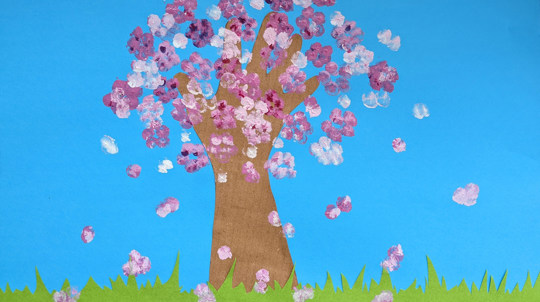
Blossom is definitely one of the highlights of spring. So get inspired by the frothy pink and white flowers and have a go at making your own blossom tree finger painting.
Materials you'll need
- pink and white paint
- card
- glue
- a twig
How to make
- Start by finding a suitable twig. It should be fairly flat with plenty of bits branching off the main stem.
- Glue the twig to a piece of card to make a 'tree'.
- Now for the messy part! Use your finger to dab white and pink petals along the branches of your twig.
Take a look at our video below to see this simple spring craft in action.
11. 3D paper tulips
This spring art project is ideal for older children who enjoy getting creative with paper crafts.
Materials you'll need
- coloured paper
- card
- cocktail sticks
- scissors
- glue
How to make
- Cut lots of heart shapes out of coloured paper and fold them in half – these will become the 3D tulips. Make a template to ensure they are all the same size.
- Wrap a long strip of green paper around a cocktail stick to create the tulip stem. Glue it to a piece of card.
- Cut small leaf shapes out of green paper and glue them next to the stem.
- To build the 3D tulip flower head, apply glue to one side of a heart and stick it at the top of the stem. Apply glue to one side of another heart and stick it to the unglued side of the first heart. Repeat until you have a full tulip, then stick the final heart to the card to secure it in place.
- Repeat these steps until you have a bright bunch of beautiful tulips.
Which craft will you try first? Why not head out into the woods this spring and look for some inspiration before you come home and create your spring flowers? You never know what you might discover!
Identify wildflowers on the go
Discover wildflowers when you're out and about with your mini pocket guide to the UK's common woodland plants.
Visit our shop