Of all the animal species known to science, one in four is a beetle.

In fact, beetles are so dazzling in their diversity that when famous British evolutionary biologist J.B.S Haldane was asked what science had revealed about God, he apparently replied that the creator had ‘an inordinate fondness for beetles.’

Many modern-day beetle lineages appeared in the Jurassic period and shared the Earth with dinosaurs. Hundreds of millions of years later, they remain one of our most bizarre, varied and fascinating groups of insects.

Read on to discover surprising facts about beetles, as well as 10 weird and wonderful species found in the UK. 

What is a beetle?

Beetles are a group of insects that belong to the biological order Coleoptera, meaning ‘sheath-winged’. This is due to the hard, leathery forewings (called elytra) which meet in a line down their back, shielding and protecting their delicate hindwings.

Beetles also almost always have chewing mouthparts (known as mandibles) which they use to chomp on solid foods. Their life cycle unfolds over four distinct stages: egg, larva, pupa then adult.

Credit: Mike Read / naturepl.com

What do beetles eat?

Thanks to their chewing mouthparts, beetles have incredibly varied diets. While 7-spot ladybirds munch on aphids, stag beetle larvae rely on rotting wood, sexton beetles prefer decaying animals and blue ground beetles prey on enormous slugs such as the ash black.  

Credit: WTML

Where do beetles live?

Beetles are incredibly adaptable and resilient, and can live more or less anywhere. Their homes range from caves, forests, heathlands and deserts to freshwater and coastal habitats. Around 1,000 beetle species in the UK are dependent on trees and woodlands for food and shelter. 

Credit: Keith Burdett / Alamy Stock Photo

Why are beetles important?

Unsung heroes of the natural world, beetles play an incredibly important role in maintaining the health of our ecosystems. Their tireless contributions include pest control, plant pollination, grave digging, dung removal, soil aeration, and nutrient recycling, to name but a few.  

One study suggested that dung beetles save the UK cattle industry £367 million a year, in large part by improving soils and helping the grass to grow.  

Credit: Zoonar Gmbh / Alamy Stock Photo

How many species of beetles are there?

So far, scientists have recorded around 400,000 species of beetle. But we know there are many more that we haven’t discovered yet – it is estimated there could be up to two million beetle species across the planet.

Identify minibeasts 

Explore woodland creepy crawlies, from bugs and beetles to snails and spiders, with a pocket-sized swatch book.

Buy it now

10 beetle species to spot in the UK

Rainbow leaf beetle

A metallic green body, flashy crimson and blue stripes and a golden sheen earn this beetle its colourful name. These dazzling insects can survive in a remarkable variety of habitats, from dense forests and windswept grasslands to open meadows and derelict wastelands at an altitude of over 600m above sea level.

However, in the UK they are extremely rare and are found exclusively on the montane grassland of Mount Snowdon in Wales – hence their nickname ‘Snowdon beetles’.

Green tiger beetle

Among our fastest insects, green tiger beetles reach dizzying speeds of 0.5 metres per second in pursuit of spiders, ants and caterpillars across sand dunes, heathland and grassland. Scaled up to our size, that’s the equivalent of a human running 50 metres in a single second!

In fact, this lightning pace is too much for their eyesight to keep up with. Whilst on the move, these agile hunters are rendered temporarily blind and must screech to a halt regularly to relocate their prey.  

Did you know?

The ancient Egyptians associated scarab dung beetles with Khepri, god of the rising sun. They believed Khepri moved the sun across the morning sky, just as these sacred beetles pushed balls of dung across the ground. 

Minotaur dung beetle

Best known for rolling around big balls of animal poo, dung beetles are thought to date back at least 115 million years and may well have eaten dinosaur droppings!

There are over 60 species in the UK, including the imposing three-pronged minotaur beetle, which feeds on and buries (but doesn’t roll) rabbit droppings. Eating faeces might seem unpleasant, but these ecosystem engineers keep the world clean and healthy by removing waste, redistributing nutrients and improving soils.

Stag beetle

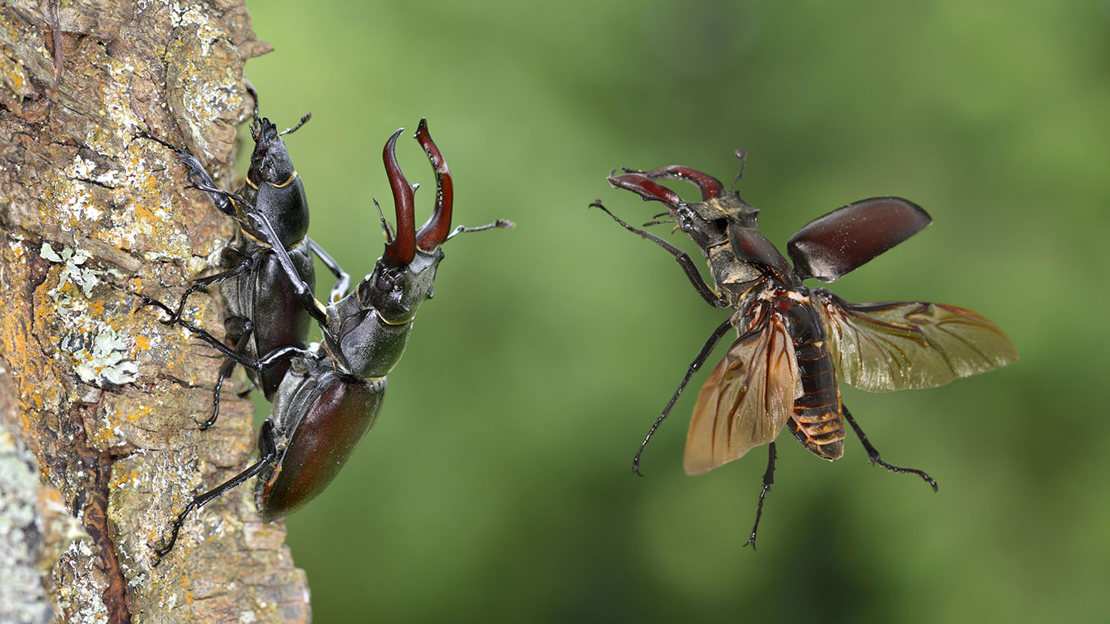
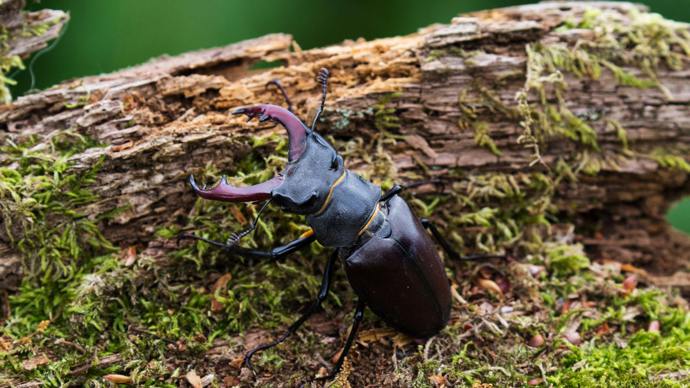
Sporting formidable, antler-like jaws, male stag beetles can reach up to a whopping 7.5cm (3 inches) in length, comfortably claiming the title of the largest beetle in the UK – as well as in the whole of Europe! Larvae shelter in and feed on decaying wood for four to six years before emerging as adults, so deadwood habitats such as rotting tree stumps are essential for their survival. 

London is a stronghold for this iconic beetle, with populations in the Thames Valley ranking among the largest in the world.

Did you know?

When threatened, violet oil beetles secrete toxic, oily droplets from their joints to deter prey.  

Violet oil beetle

Violet oil beetles have a bizarre and adventurous life cycle. Females lay hundreds of eggs in underground burrows. The hatched larvae (known as ‘triungulins’) clamber up the nearest flower. If a solitary mining bee arrives, larvae use their hooked feet to latch onto the bee and hitch a ride back to its nest, where the larvae will devour the bee’s eggs as well as its stores of nectar and pollen. Nestling down in the now-empty bee burrow, the young triungulins will develop into adult violet oil beetles and the life cycle begins anew. 

Glow worm

Dubbed ‘Earth-Born Stars’ by poet William Wordsworth, female glow worms emit an ethereal light from their abdomen to attract a mate, using a chemical reaction known as bioluminescence. Adults cannot feed, so time is of the essence. Females glow for around ten nights, stopping once they have mated and dying shortly after laying eggs.

Their larvae have honed an efficient and gruesome hunting technique: injecting snails with paralysing toxins, then riding on their shell until they can slurp up the liquified remains of their prey. 

Did you know?

In 1999, NASA sent aphids and ladybirds into space to observe whether aphids could escape their predators without the help of gravity.

7-spot ladybird

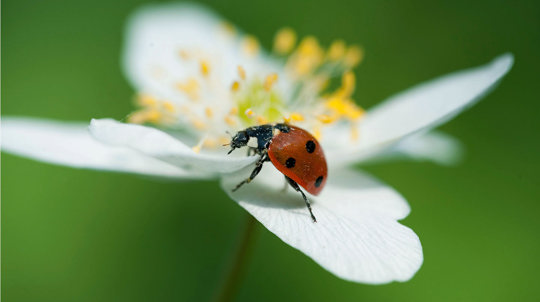
Gardeners love these pest-munching insects, as a single ladybird can devour 5,000 aphids during its year-long lifespan! The 7-spot is one of more than 40 species of ladybird native to the UK.

They may look cute, but their vivid red-and-black colours are designed to ward off hungry predators (though some birds may try their luck anyway). What’s more, they can release a stinky yellow fluid from their joints as a further defense mechanism.

Blue ground beetle

These jewel-like beetles were thought to be extinct in the UK until 1994, and since then have been identified across just 15 sites in South Wales and South West England, including Bovey Valley Wood.

Having wing cases but no wings, blue ground beetles are flightless. Instead, these nocturnal hunters roam many miles under cover of darkness, climbing up mossy trees in pursuit of a tasty meal such as ash black and tree slugs. Using their sharp pincers, blue ground beetles grab their prey and inject them with digestive juices, then drink the resultant slug soup. 

Bloody-nosed beetle

This flightless, slow-moving beetle has a trick up its sleeve – or rather, up its nose. When detecting a nearby threat, the bloody-nosed beetle will ooze a foul-tasting, brilliant red liquid from its face to scare off any potential predators. The larvae are black with a blue metallic sheen and can be found hanging from lady’s bedstraw, a favourite foodplant of this species. 

Common sexton beetle

Named after sextons of the church, who would tend to graveyards, the common sexton beetle is nature's undertaker. These burying beetles have sensitive antennae capable of detecting the rotting remains of small animals from as far as two miles away, which they will seek out and bury.

Then comes the grisly part: females will lay their eggs on the deceased animal, so that freshly hatched larvae can feast on its corpse. Unusually for beetles, both male and female will stay and care for their young until they are grown. 

Discover more about British beetles

Identify minibeasts 

Explore woodland creepy crawlies, from bugs and beetles to snails and spiders, with a pocket-sized swatch book.

Buy it now